Skip to content

Can I Measure Opacity When I Have Water in my Flue Gas?

mercredi, novembre 15, 2023 | Derek Stuart
Catégories : Products

One of the most common questions I receive from customers is, “What effect does water have on my opacity reading?”.

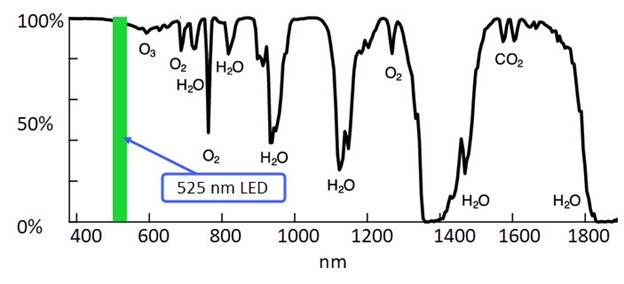
The answer depends on whether the water is present as vapour or as condensed droplets. All AMETEK Land opacity monitors operate at a wavelength of 525 nm in the green part of the visible spectrum. As shown in Figure 1, none of the common atmospheric gases, including water vapour, absorb at this wavelength. Since there is no absorption, the opacity reading is not affected by water vapour, even at high concentrations.
Can I Measure Opacity When I Have Water in my Flue Gas?
Figure 1 Atmospheric transmittance versus wavelength, with LED spectrum shown in green

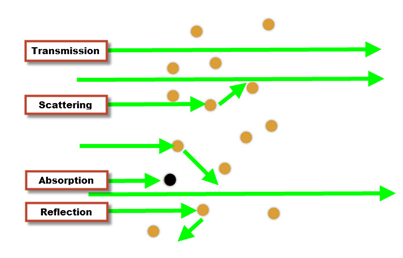
An opacity monitor works by measuring the amount of light lost through scattering and absorption by particles in the flue gas, as shown in Figure 2. If there are no particles, there is no loss of light and the opacity reading is 0%. Unfortunately, an opacity monitor cannot distinguish a water drop from a dust particle, so it will indicate a high opacity value if there are droplets of condensed water in the gas stream. 
Can I Measure Opacity When I Have Water in my Flue Gas?
Figure 2 Light Scattering

In most cases, the flue gas temperature remains well above 100 °C (212 °F) at all times, so the water always remains in the vapour phase. The main exception to this is after a wet flue gas desulphurisation (FGD) plant, where a slurry of limestone and water is sprayed into the flue gases to absorb the sulphur dioxide. The gases downstream of the FGD generally have a high concentration of condensed water and will always have an opacity of 100%. For this reason, an opacity monitor should not generally be installed after a wet FGD.

Condensed water is also possible in cases where the flue gas temperature is only a little above the dewpoint. In this case, the cool purge air from the instrument can cause the temperature to drop below the dewpoint when it mixes with the flue gases, leading to local condensation. Unlike the wet FGD, this is a small effect and generally leads to a small increase in the measured opacity. Increasing the flue temperature by a few degrees is generally sufficient to prevent this effect.

Click here to learn about our opacity monitors

Archives

Skip Navigation Links.
Collapse 2023(25)2023(25)
Collapse November(4)November(4)
Importance of Reliable Slag Detection
How to Enhance Combustion with NIR-Bs to Reduce Emissions and Boost Energy Efficiency
Ensuring Quality and Control in Auto-pour Processes for Foundry Castings
Can I Measure Opacity When I Have Water in my Flue Gas?
Collapse October(2)October(2)
What is EtherNet/IP and Why Do I Need It?
How Critical is Measurement of Temperatures in the Aluminium Industry?
Collapse August(1)August(1)
Industrial Thermal Imaging Benefits in Heat Treatment Applications
Collapse July(1)July(1)
Why Should I Use Two NIR-Bs on Container Glass Furnaces?
Collapse June(1)June(1)
Exploring Career Opportunities at AMETEK Land: Your Pathway to Success
Collapse May(3)May(3)
SPOT AL: Revolutionising Aluminum Extrusion with Precision Temperature Control
5 Practical Tips for Using the Gold Cup to Measure Tube Wall Temperatures
Making Smart Investments in Non-Contact Temperature Measurement Technology
Collapse April(3)April(3)
INDUSTRY 4.0 & 5.0 in Non-contact Temperature Measurement Applications and Devices
Gas Concentration Measurements in Glass Melt Tanks with a Portable Gas Analyser
How to Use the New LWIR-640 and its IMAGEPro Software to Monitor the Exterior of a Glass Furnace and Avoid Glass Leaks
Collapse March(3)March(3)
What is Dual-Sensor Technology?
Maintaining the Reliability and Safety of Steam Methane Reformers through Outlet System Monitoring
Combining a Transportable NIR-B-2K & Lancom 4 for Thermal Surveys & Combustion Optimisation
Collapse February(4)February(4)
Using Fiber-Optic Instruments (FGs) for Live Temperature Monitoring in Container Glass Furnaces
Combustion Control in a Black Liquor Boiler
Benefits of Using Medium-wavelength (MWIR) Thermal Imagers Instead of Widely Used Long-wavelength (LWIR) Cameras
10 Reasons Why Thermal Cameras Are Preferred to Video Cameras for Furnace Monitoring.
Collapse January(3)January(3)
Steam Methane Reformer (SMR) Tube Metal Temperatures (TMT) Data Collection and Correction
How to Improve Temperature Gradient and Quality of Glass Ribbons Using The LSP-HD Linescanner
Understanding the Importance of 'HOT SPOT' Measurement in Non-Contact Temperature Measurement Applications
Expand 2022(30)2022(30)
Expand 2021(19)2021(19)
Expand 2020(15)2020(15)
Expand 2019(15)2019(15)
Expand 2018(9)2018(9)