AMETEK Land’s new SPOT+ pyrometer features a wide range of communications interfaces, including EtherNet/IP REST API and Modbus TCP/IP. This blog will describe the functions of the EtherNet/IP interface.
Industrial Internet of Things (IIoT) is sometimes called
“Industry 4.0”. It refers to an interconnected network of sensors, instruments, actuators and other devices used in an industrial setting. EtherNet/IP, or Ethernet Industrial Protocol, is an industrial networking protocol which is widely used, especially in the USA. It had its origins in the early 2000s and now has around a 30% share of the industrial Ethernet market. It is supported by Beckhoff embedded PCs, Rockwell Logix PLCs and other popular networking hardware.
As with all IIoT protocols, EtherNet/IP allows manufacturers to improve their competitiveness by
•
Using smart instruments and machines that can share and log data
•
Connecting them to cloud computer systems that can store and process the data
•
Analysing the data with data analytics and artificial intelligence to produce useful information
•
Providing the information to employees who can use the insights to improve performance
EtherNet/IP uses standard Ethernet hardware which allows for economies of scale and gives access to a wide range of suppliers. It allows for a unified communication architecture throughout a manufacturing site. The EtherNet/IP protocol handles the high-level functions that facilitate the data exchange among the items on the network.
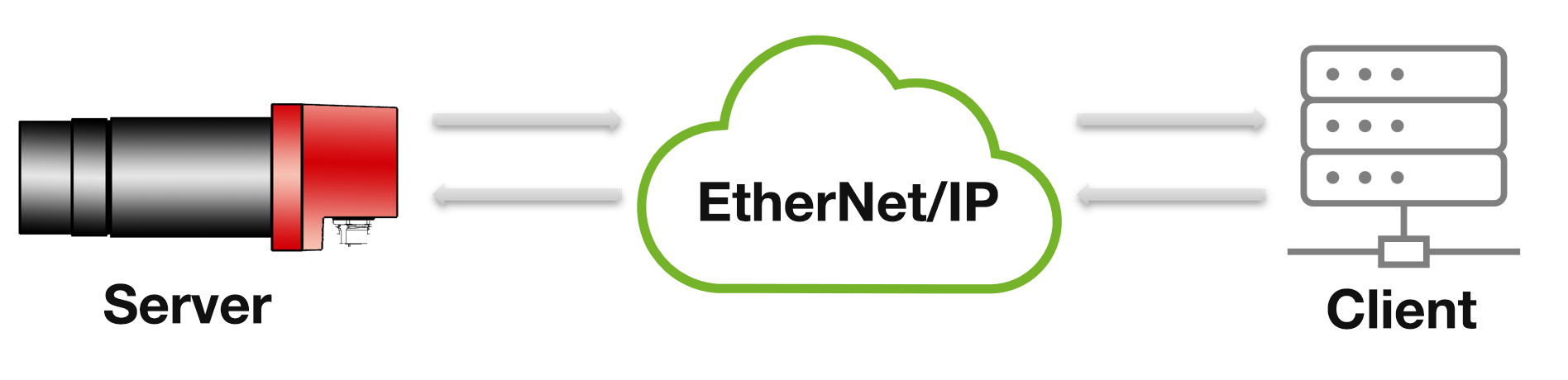
It is a client / server protocol that allows any device on the network to be a client, requesting data from a server.

It is easy to confuse EtherNet/IP with TCP/IP as their names are very similar. TCP/IP stands for Transmission Control Protocol/Internet Protocol and is a suite of communications protocols used to connect devices on the internet. It is a much older protocol than EtherNet/IP and specifies how data is exchanged over the internet, or a private intranet.
Each EtherNet/IP device has an electronic data sheet (EDS), a text file which specifies the data types and formats available from the device. It is used as part of the network configuration and tells the network clients how it can access data from the device. The
EDS for SPOT+ can be downloaded from the AMETEK Land website.
Although EtherNet/IP is a fast, flexible and powerful protocol, it has some limitations. One important consideration is that it is non-deterministic, which means that a message’s delivery time is not guaranteed. This can be important in some time-critical applications.
The EtherNet/IP interface on
SPOT+ allows the user to access all of its measurement functions as well as its principal settings such as emissivity and background temperature.